How to Develop Your Own Voice and Become a Great Composer: The Ligeti Model

In the spring of 2007, Simone Fontanelli, a world renowned composer and professor of new music at the University of Mozarteum in Salzberg, gave a series of seminars at the University of Georgia, Dancz Center for New Music. I asked maestro Fontanelli, “are there any composition exercises you would recommend to help beginning composers develop their own voice?” He suggested borrowing harmonic, melodic and/or rhythmic ideas from three great composers, then write a new piece which combines the best elements of all three. For example, combine Stravinsky’s Petrushka chord, Bartok’s rhythmic motives from String Quartet No. 4 and Schoenberg’s concept of developing variation into a single composition. This is challenging to say the least, and it stretches the abilities of most composers. In addition, this exercise gives beginning composers an opportunity “walk in the shoes” of the world’s greatest composers, thereby, discovering what makes them great. It also helps beginning composers get into the historical flow of what has gone before them.

This idea is not new. All great composers have written pieces “in the style of…” For example, Mozart was influenced by Bach, Haydn and many others. Schoenberg considered himself to be an extension of the German tradition and was influenced by Bach, Beethoven and Brahms.

While working on my DMA in music composition at UGA, I read a number of interviews with György Ligeti (1923-2006), one of the most influential composers of the 20th century, in which he discussed the influence of Bartók on his compositional style and technique. Ligeti used Bartók’s String Quartet No. 4 as a model when he wrote String Quartet No. 1: Metamorphosis Nocturnes (1954). In fact, in an interview with Friedemann Sallis, Ligeti stated he knew Bartók’s style so well that “he could have gone on to write the seventh, eighth or even twelfth Bartók quartet.”
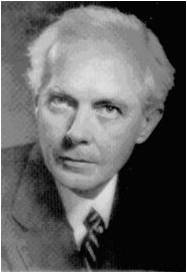
Bartok Ligeti

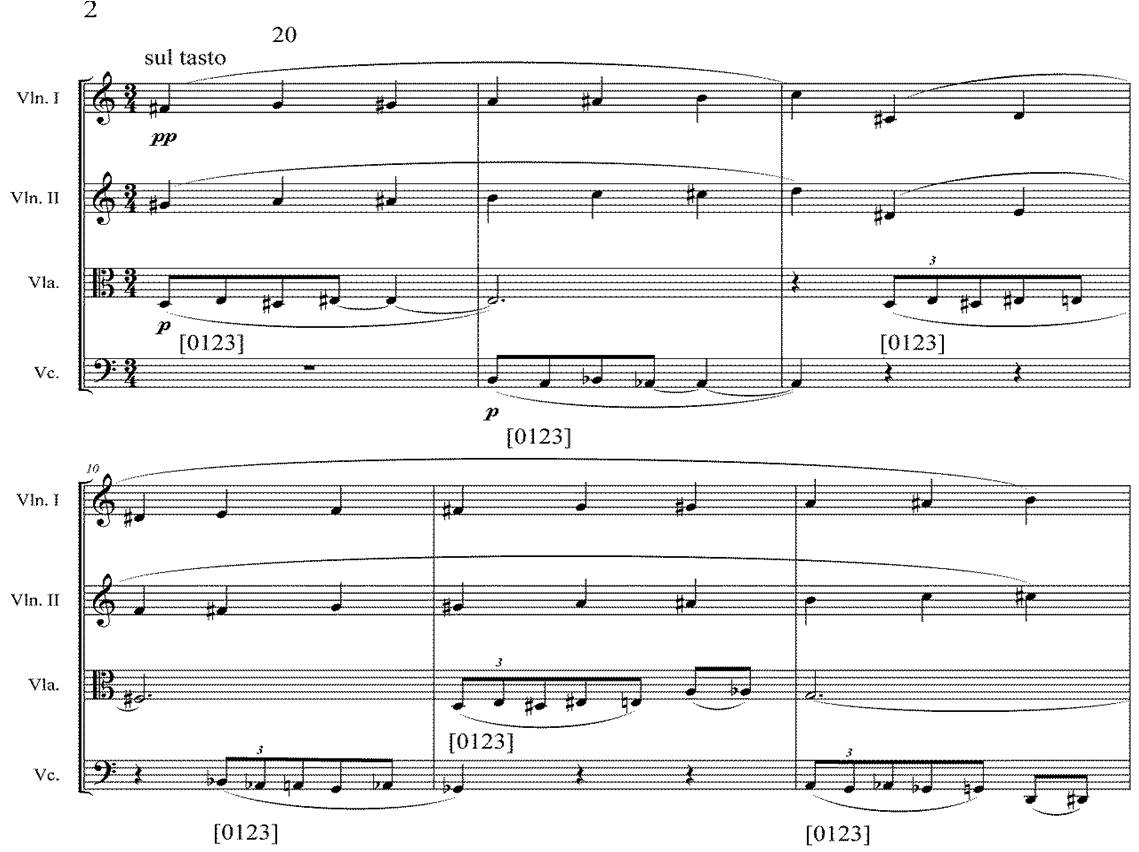
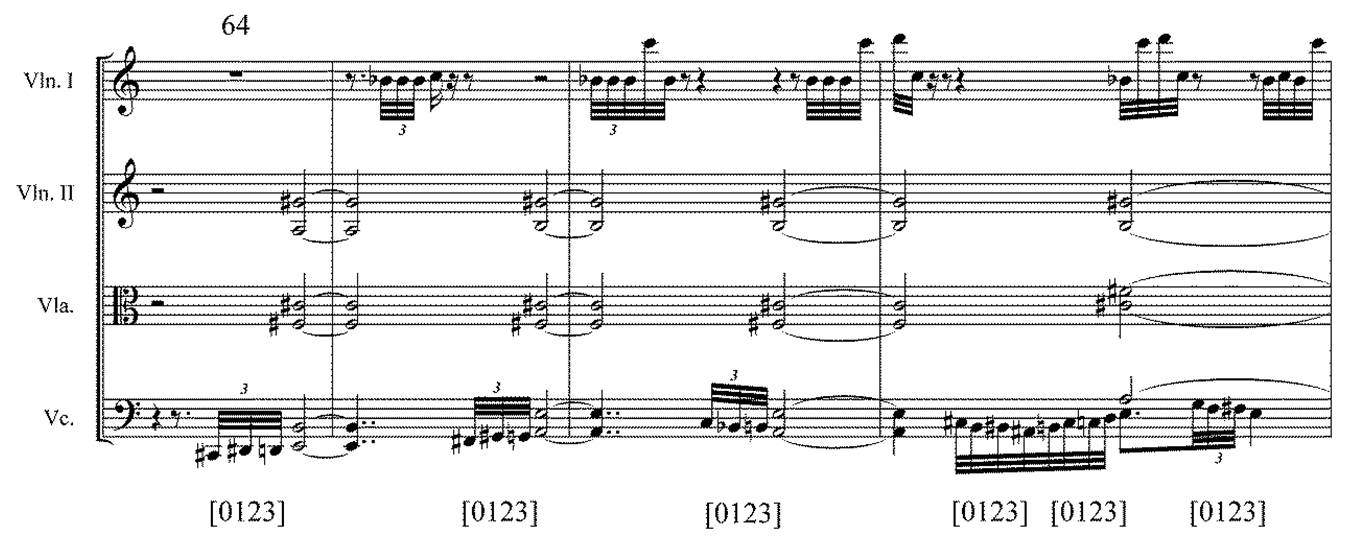
I decided to analyze both quartets to determine if this statement is true and, if so, discover what elements of Bartók’s quartet and style are present in Metamorphosis Nocturnes. It appears that Ligeti borrowed a motive directly from Bartók’s quartet, see Example No. 1. This motive belongs to set class [0123]. Ligeti uses it in the beginning of Metamorphosis Nocturnes, and it becomes the primary harmonic structure throughout the entire quartet, see Example No. 2. It is interesting to note, after writing Metamorphosis Nocturnes, Ligeti continued to use set class [0123] throughout his career, but he added his own twist in the form of microtonality.

Example No. 1
Barok example

Example No. 2Ligeti example

There are a number of parallels between these two quartets, and Bartók’s influence is present throughout to the extent that Ligeti’s quartet sounds more like Bartók than Ligeti. With that being said, Metamorphosis Nocturnes is a model for all aspiring composers. Ligeti wrote his quartet in order to experiment with Bartók’s harmonic and melodic language. He ultimately kept what he liked most from Bartók’s style, eventually making it his own. In the process, he developed his own unique voice. March 20-23, I will present my research at the 2014 Society of Composers Inc. Nation Conference at Ball State University in Indiana.

I would recommend trying the same experiment with your own favorite composer or composers. Borrow a melody/harmony or two. Take it out for a test drive. If you like it, find a way to make it your own!

Is There a New Minimalism Underway in Popular Music?

Is there a new minimalism underway in popular music? It seems two of the most recent number one songs, “Blurred Lines” and “Royals,” consist of little more than a catchy percussion driven beat with bass and harmony vocals. It is a very effective combination, if the lyrics are strong, because minimal accompaniment focuses the listener’s attention on the words making them more important to the success of the song.

There are a number of artists who have built careers using minimal accompaniment including Bob Dylan, in his early folk period, and Neal Young. Can you name other artists who use minimalism?

Photo courtesy of billboard.com.

Fragmentation and Melodic Development

Fragmentation is an interesting tool which composers can use to generate a plethora of melodic material with very little effort. In my opinion, there are two primary types of fragmentation, subtractive and motivic.

Subtractive fragmentation is easy to do and, if used properly, creates syncopation. All you have to do is substitute rests for notes. Example No. 1 is an original melody which I have used in a number of previous blog posts. Example No. 2 is the same melody with rests replacing some of the notes. Play both examples and listen to the difference. Example No. 2 is clearly the same melodic idea, but it has more rhythmic punch because the rests create accented upbeats in measures 2 and 4. The quarter rest in measure 3 creates additional rhythmic interest.

Example No. 1

Original

Example No. 2

Subtractive Fragmentation

Motivic fragmentation is more common than subtractive. In fact, it is an integral part of classical period repertoire and is common in compositions by Haydn, Mozart, and Beethoven. In general, the primary thematic structures used in classical period music where the sentence and period. It is beyond the scope of this blog post to discuss thematic structures in classical period music, but, in general, a basic idea is introduced (usually two measures), repeated creating a four measure theme, then a fragment of the basic idea is extracted and sequenced three times to create a classic eight-measure sentence structure. In example No. 3, the eighth notes in measure 2 are extracted and sequenced three times to create an ascending melodic line which cadences in measures 7-8. This creates a sense that the melody is accelerating toward a cadential point.

Example No. 3

Motivic Fragmentation

Comment if you can think of any other types of fragmentation. In the meantime, apply these techniques to your own compositions and listen to the results. Happy composing!

How to write a film score like Danny Elfman

According to buzzfeed.com, while making Nightmare Before Christmas, “Composer and lyricist Danny Elfman didn’t have a script to write the songs from. He asked Tim Burton to describe a scene and then Elfman would compose the song.” From a slightly biased composer’s perspective, this is an excellent example of how a film should be made.

anigif_enhanced-buzz-29802-1382981015-41

Often, filmmakers don’t consider music or sound until the very end of the project. At which point, there is very little budget left, and all of the creative decisions have been made. The music must conform to the visuals; not a collaborative model at all. In my opinion, the music should influence the film and vice versa.

I learned this lesson from personal experience. As a graduate teaching assistant, I created an electronic music composition inspired by Federico García Lorca’s Poems of the Deep Song. It featured electronically manipulated classical guitar samples and a film by a very talented artist. My mistake was to write the music first, then expect the artist to make her film conform to my vision of the music and poetry. There are moments which work perfectly, but overall it would have been better if I had collaborated more closely with the artist from the beginning. In my case, I put the music first and the film second.

On the other hand, I worked on music and sound design for Interactive Science in 3d, an educational video game group at UGA funded by the National Institute of Health. It was a great collaborative experience. The game designers presented me and my colleague with an in-progress game. We composed a short piece for the opening scene and sent it back to them for approval. They liked it so much, they redesigned the beginning of the game to fit seamlessly with our music. The score inspired the design and vice versa. It was very effective and a lot of fun to see the final results. Check out the video below.

In my opinion, Nightmare Before Christmas is so successful because of the collaborative arrangement between Tim Burton and Danny Elfman. The music inspired the film’s visual design making it one of the greatest Halloween films of all time.

Can you name other films that follow this collaborative model?

How to Develop a Melody Using Sequencing

Sequencing is another time-honored tool that most composers use on a regular basis. Sequencing is the immediate repetition of a motive at a higher or lower pitch level. The motive can be almost any length the composer desires as long as it is not a complete repetition of the entire phrase. Often the motive is quite short, just a few beats or a single measure.

I particularly like to use ascending sequences. They create a sense of growing intensity and anticipation, as if something important is about to happen. They work well as transitions to new sections or as a build up to an important climactic moment.

There are a number of different types of sequences. Two of the most used sequences are exact and tonal. Example No 1 is an original melody which I used in my first blog post to demonstrate inversion, retrograde, and retrograde inversion. Example No. 2 is the same melody subjected to exact sequencing. All of the intervals in each sequence are exactly the same as the original melody. Accidentals have to be added to maintain the intervallic relationship among the notes. This is sometimes referred to as a modulating sequence because, with the addition of so many accidentals in measure 4, the phrase has essentially modulated to the key of C# major.

Example No. 1

original

Example No. 2

sequencing exact

Example No. 3 is the same melody subjected to tonally adjusted sequencing. None of the sequences have accidentals; therefore, the phrase remains in the key of F# minor.

Examples No. 3

tonally adjusted sequencing

Three and out is the general rule for sequencing. In other words, whatever you decide to sequence should only be sequenced three times; anything longer feels predictable and tedious.

In addition, it is advisable to vary the sequences. Change some of the notes or invert one of the sequences to keep the listener off balance. Most people are sophisticated enough to understand that a sequence is in progress and can predict what it will sound like as it unfolds. If one of the sequences, usually the third, is a little different, it will keep the audience off balance and engaged. If they can predict exactly what you are going to do next, you have lost them. Keep them engaged with unpredictable twists and turns. Example No. 4 demonstrates this concept. The last sequence is inverted; all of the intervals are upside down.

I encourage you to play through these examples, then apply sequencing to one of your own melodies and see what happens. Enjoy!

Example No. 4

exact with inversion

How to Write a Melody: Augmentation and Diminution

Augmentation and diminution are two widely used compositional techniques that can be applied to almost any melody. In this blog post, I will show you how to use these techniques to generate a plethora of new material for your next composition.

There are two types of augmentation, rhythmic and intervallic. Rhythmic augmentation means that all of the note values in a given melody are increased by an equal amount. In most cases, rhythmic values are doubled, but they can be increased by almost any amount. Example No. 1 is an original melody used in my first blog post to demonstrate retrograde, inversion, and retrograde inversion. Example No. 2 shows this melody with its note values doubled.

Example No. 1

original melody

Example No. 2

aug

Intervallic augmentation means that all of the intervals increase, see Example No. 3. This changes where notes fall in relationship to the underlying harmony, so the accompaniment usually needs to be adjusted to compensate.

Example No. 3

intervallic aug

Diminution is the opposite of augmentation. All of the note values and/or intervals are shortened by an equal amount, see Example No 4.

Example No. 4

Rhythmic dim

Example No. 5 is an augmented version of the original melody with sixteenth-note accompaniment. The accompaniment pattern is also a good example of diminution in action. Counts one and two in measure 1 are the original melody in diminution, see Example No. 1. Notice it’s the same melodic contour in sixteenth notes. Essentially, Example No. 5 is derived from a single motive which is subjected to both augmentation and diminution. See what you can do with just a few ideas and an arsenal of composition techniques in your tool chest?

Example No. 5

aug and dim example

How to Write a Melody, A Video Example

I recently discussed the value of inversion and retrograde, two compositional techniques, in an earlier post.

Here is an original composition for classical guitar, “Rainy Nights for Jennifer”  that demonstrates these techniques. The first example of inversion occurs at 1:48. There are a number of other examples throughout the composition, especially after the tempo change at 2:05.

This was a live performance at the Atlanta Institute of Music.

Let me know what you hear.

CDZA’s Journey of Guitar Solo

CDZA or Collective Candenza is Joe Sabia, Michael Thurber and Matt McCorkle, a group located in New York that creates musical video experiments. Their most recent offering is Journey of Guitar Solo (THE INSTRUMENTALS – Episode 1), which is currently trending in social media since it was featured on Huffington Post.  The video takes viewers through a brief history of guitar solos in popular music. (full video below)

Many of the comments and much of the discussion revolves around what bands or guitarists the group left out or neglected to mention in their medley. One can definitely argue that David Gilmour deserves a mention. And Slash’s “Sweet Child of Mine “ is labeled the  “Highest Level of Epicness.” What the what? A great solo, but I can think of a dozen solos that are considerably more “epic.”

What I really appreciate is their call to action at the end of the video. Fact Man steps to the center of the frame wearing a sign that reads “Learn an Instrument Because It’s FUN!” I couldn’t agree more.

As a music instructor of guitar, composition and music theory, I have seen a definite decline in the number of young people who are interested in learning an instrument, particularly guitar, an instrument which is definitely fun to play, but requires dedication, focus, and determination, three traits not encouraged in today’s instant gratification, ultra-connected, cyber world.

Learning an instrument is a Zen experience, which requires complete concentration, focus and imagination. Some of the best times of my life involved making music with my friends and being proud of what we did. I hope we are not losing an entire generation of young musicians and guitarists to the ultra slick iPhone experience. It’s fun to bicker about what guitarists and bands were left out of a medley which attempts to do the impossible, encapsulate fifty plus years of music into a single six-minute video experience. I say kudos to CDZA  for encouraging its audience to “Learn an Instrument Because It’s Fun!”

How To Write A Melody

One of the most challenging aspects of music composition is thematic development. As a composition instructor, I have found most of my students can come up with convincing melodic, gestural, or textural ideas, but they struggle when writing an entire piece. Most students get “stuck” at a particular point, get frustrated, and eventually give up. The problem is they don’t know how to develop their initial ideas, and their progress grinds to a halt. Fear not! For the professor is here to give you the tools you need to become a great composer.

Here is a partial list of some time-honored compositional tools. These tools can be applied to almost any style of music. Comment if you can think of anything I have left out, and I will add it to the list.

Capture2

In this blog post, I will focus on inversion, retrograde, and retrograde inversion, by far the most widely known and beloved compositional tools. Inversion means all of the intervals in a particular melody are upside down. Example No. 1 shows an original melody followed by its inversion. Notice that the ascending triad in measure 1 becomes a descending triad when inverted, a mirror image of the original melody.

Example No. 1

melodic development blog pic 1

There are two types of inversion, exact and tonally adjusted. In an exact inversion, all of the intervals are exactly the same as the intervals in the original, only upside down. In a tonally adjusted inversion, the most common type, intervals are modified to stay within the key. The above example is a tonally adjusted inversion, an exact inversion would require note D in measure 1 to be a D#.

Retrograde is the original melody play backward. Example No. 2 is the original melody from Example No. 1 played backward.

 Example No. 2

melodic development blog pic 2

Retrograde inversion is the inversion played backward. Example No. 3 is the inversion of the original melody played backward.

Example No. 3

melodic development blog pic 3

I encourage you to play these examples on your instrument. Notice how each one has its own character, yet sounds related to the original melody. This is because the intervallic and rhythmic content is virtually identical in each example, so the next time you find yourself “stuck,” apply these compositional tools to your melody, and see if it generates new material. If you like your original idea, you will probably like the inversion, retrograde, and retrograde inversion as well. It is similar to looking at a beautiful painting in a mirror. If it looks great on the wall, it will look great in a mirror too. Enjoy!