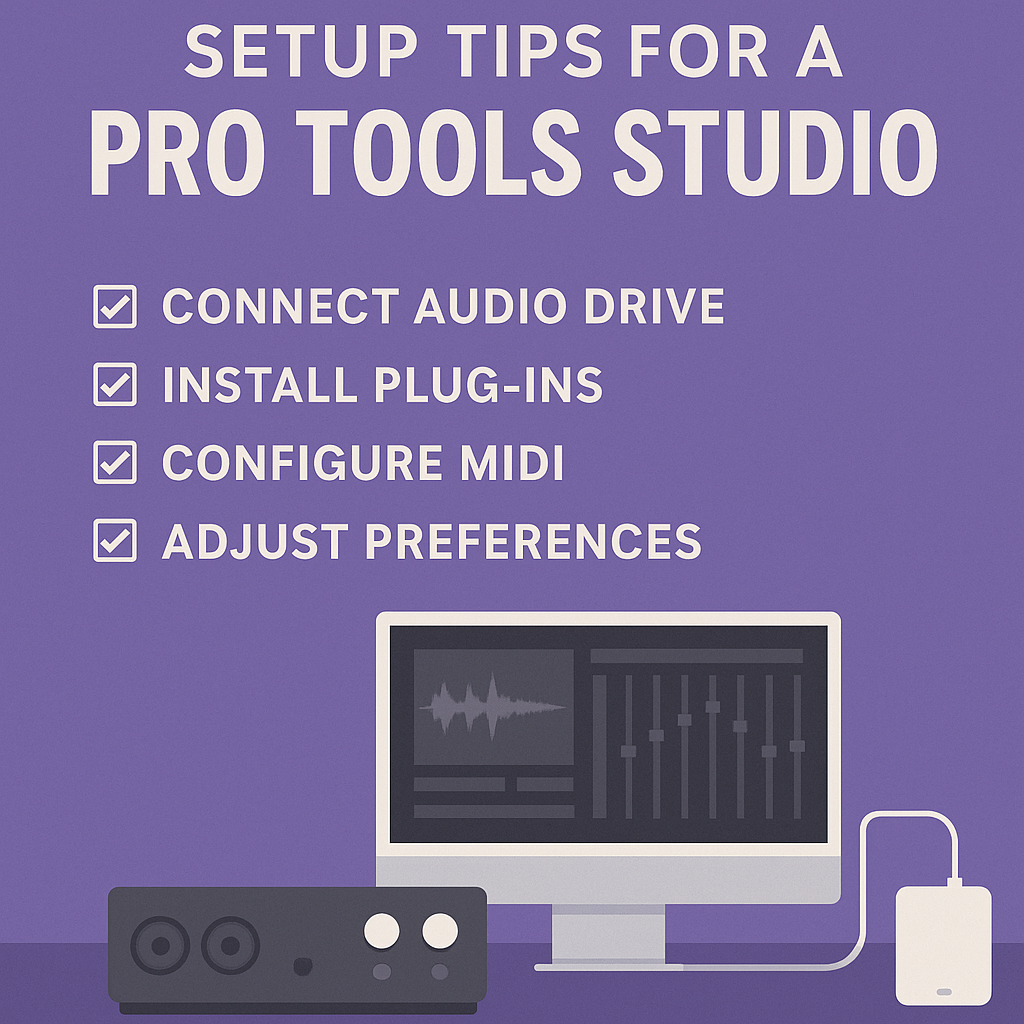
Over the past few weeks, I’ve been upgrading my Pro Tools system and studio workflow. If you’re setting up a new system — whether you’re a musician, educator, or audio professional — I want to share the steps I used to tune my rig for professional-level performance.
My system now runs effortlessly — even with large sessions and demanding sample libraries — and I hope this guide helps you do the same.
🎼 My System:
Mac mini (2024) M4 — 24 GB RAM
macOS Sequoia 15.5
Pro Tools Studio
Universal Audio Volt 2 interface
Native Instruments Komplete Standard 15
Kontakt 7, Reaktor 6, Session Strings 2, and more
🚀 Why This Matters:
A lot of musicians and educators ask:
“How can I keep Pro Tools running fast — even when using big Kontakt libraries or mixing large sessions?”
The key: setting up two external SSDs and tuning Pro Tools to use them properly.
1️⃣ Disk Allocation: Made sure all Pro Tools tracks are recording to Sessions SSD — no stray files going to internal Mac drive.
2️⃣ Disk Cache: Set Pro Tools Disk Cache to 8 GB (for M4 Mac mini w/ 24 GB RAM). Result: playback is smooth, no lag — even with big Kontakt instruments loaded.
3️⃣ Libraries Relocation: Moved my Kontakt Factory Library, Reaktor Factory Library, Session Strings 2, and other key libraries to SSD #1 — and repaired paths in Native Access.
4️⃣ MIDI & Playback Engine: Playback Engine set to Volt 2 MIDI working smoothly — both USB and 5-pin MIDI cables tested
5️⃣ Pro Tools Preferences: Auto-backup enabled Project Cache verified Disk Allocation pointing 100% to SSD #2
💻 Final Results:
Pro Tools now runs perfectly stable — even with: 🎼 24+ audio tracks 🎼 Multiple Kontakt instances 🎼 Real-time guitar playing through amp sims 🎼 Large virtual instruments and Reaktor patches
🎙️ Why This Works:
When you separate your sample libraries from your session audio — and tune your Disk Cache and Disk Allocation — Pro Tools and Kontakt can both stream without fighting for disk bandwidth.
This is the same strategy you’ll see in commercial studios — and it works beautifully on a compact Mac mini rig.
🎹 Final Takeaway:
If you’re running Pro Tools on an M-series Mac, and working with:
✅ Big Kontakt libraries ✅ Pro Tools sessions with 24+ tracks ✅ Real-time tracking of vocals or instruments
…then two external SSDs + tuned Disk Cache will give you professional-level performance — and peace of mind.
If this helped you — or if you have questions about setting up your own Pro Tools system — feel free to reach out. I love helping musicians and educators make the most of their gear!
— Dr. David Mitchell 🎼
P.S. I’m happy to share my full tuning checklist — just ask!
I’m thrilled to share some exciting news: The Music Composition Blog has been honored by Feedspot as one of the Top 20 Music Composition Blogs & News Websites to Follow in 2025, securing the #7 spot on their prestigious list. This recognition is a testament to our commitment to providing valuable insights and resources to the music composition community.(Feedspot – 20 Best Compositions Blogs)
Feedspot’s list highlights blogs that consistently deliver high-quality content, and being included among such esteemed company is truly humbling. I extend my heartfelt thanks to Anuj Agarwal and the entire Feedspot team for this acknowledgment.
Over the years, The Music Composition Blog has aimed to be a hub for composers, musicians, and enthusiasts alike. We’ve explored topics ranging from the fusion of classical pieces with unconventional instruments, as in my composition “Clair De Lune with Tibetan Bowls” , to discussions on the evolving landscape of music and technology . Our goal has always been to inspire and inform, bridging the gap between traditional composition techniques and modern innovations.(Clair De Lune with Tibetan Bowls)
This recognition motivates us to continue our mission of sharing knowledge, fostering creativity, and supporting the ever-evolving world of music composition. Thank you to all our readers and supporters for being part of this journey.
Warm regards,
Dr. David Mitchell
Composer, Educator, and Director of Education at the Atlanta Institute of Music and Media
In recent years, the intersection of AI and music has ignited spirited debates around creativity, authenticity, and—of utmost concern to artists—compensation. YouTube’s experimental Dream Track AI feature exemplifies how these technologies can shape both the future of music and the income landscape for creators. At its core, Dream Track uses artificial intelligence to generate short soundtracks in the distinctive styles of participating artists, from Demi Lovato to T-Pain, allowing creators to infuse their YouTube Shorts with personalized soundscapes. This feature showcases a fresh opportunity for artists to reach audiences and offers a revenue model that blends passive income with artistic integrity.
Dream Track AI isn’t simply a novel tool; it represents a nascent paradigm where artists can profit from the expanding applications of AI. Each artist involved in Dream Track has entered into a compensation agreement with YouTube, receiving payment whenever their vocal style or likeness is utilized in AI-generated tracks. This model opens the door to a future where artists, whether household names or emerging talents, can earn royalties every time their voice, likeness, or musical style is utilized in AI compositions. This is the digital music industry’s response to the era of passive income, a model that could create durable, scalable revenue for musicians as AI-generated content becomes increasingly popular.
AI Collaboration: The Path to Passive Income
For participating artists, Dream Track AI creates an unprecedented opportunity to generate passive income. Historically, artists primarily earned revenue through live performances, album sales, or streams—each directly tied to their immediate input or physical presence. Now, thanks to Dream Track, artists can license their voice and style, creating revenue streams independent of new content releases or tours.
Imagine an artist who wants to step back from the relentless cycle of touring or recording yet still wants to maintain a connection to their fans. With AI-powered platforms like Dream Track, they could potentially enjoy royalties indefinitely, as users engage with their voice or style in various contexts. AI collaboration redefines what it means to “perform,” extending the artist’s reach and generating income in ways that are increasingly flexible.
YouTube, keenly aware of its role as a gatekeeper in this brave new world, has embraced AI principles that emphasize transparency and compensation. These policies are designed to protect artists from exploitation and ensure that their unique contributions are honored—both in recognition and in revenue.
Protecting Artists with New Legislation
While the potential for AI-based income is exciting, it’s also fraught with ethical and legal challenges. Many artists have raised concerns about unauthorized AI-generated uses of their voice or likeness—a stance underscored by recent legal measures. A landmark example is Tennessee’s ELVIS Act, a law that prohibits the replication of an artist’s voice without their permission. This legislation, named after one of music’s most iconic voices, reflects a growing trend to safeguard artists from unwanted AI-generated reproductions and establishes a legal basis for protecting their rights.
Furthermore, organizations like SAG-AFTRA have negotiated agreements with AI developers to ensure voice actors are compensated for the use of their digitally recreated voices. These agreements often include session fees and ongoing royalties, acknowledging that while AI may be performing the labor, it’s the artist’s essence—their voice, their style—that is ultimately on display.
Such laws and agreements don’t just prevent misuse; they empower artists. By licensing their work for AI use, artists can exercise control over their brand while tapping into new income streams. AI-generated work doesn’t have to replace artists; instead, it can amplify their reach and extend their revenue potential in ways they control.
Paving the Way for an Artist-Centric Future
The Dream Track AI experiment could serve as a blueprint for a future where artists don’t just protect their intellectual property—they thrive financially from it. Imagine if every time a music fan customized a favorite song, adjusted a style, or used an artist’s vocal timbre in their own creative projects, the original artist received compensation. This new income model could soon expand beyond YouTube, with platforms like TikTok, Instagram, and even traditional streaming services exploring similar possibilities.
In the meantime, the message is clear: the combination of AI innovation and artist protection laws is opening new doors for musicians. Dream Track AI demonstrates that these technologies can enhance the music industry rather than undermine it, creating a harmonious blend of artistry and technology where artists are rewarded, audiences are delighted, and creativity remains at the heart of it all. This is not merely a speculative future—it’s a transformative moment where the artist, finally, is in control of both their art and their income.
By embracing this vision, we can shape an industry where AI amplifies the artist’s presence, respects their work, and supports their livelihood in new, sustainable ways. In this artist-centric future, creativity is not just celebrated; it’s compensated, generating passive income that honors the integrity of the artist and the limitless potential of the music they inspire.
I was interviewed by RoydenD’Souza with Al Jazeera TV about AI and music. He found me through the Atlanta Institute of Music and Media blog. We covered a lot of interesting topics including music composition, audio production and the future of the music industry in the era of AI. Please share and let me know what you think.
AI is changing music creation, but could it displace artists? Al Jazeera's Samantha Johnson explains. pic.twitter.com/lGVvXsxymy
The rapid advancement of AI has sparked vigorous debate about its impact on the music industry. While some see its generative capabilities as threatening, I believe AI presents opportunities to empower artists and to help them connect with fans in new ways. However, protections must be in place to safeguard artists’ rights.
As an independent artist myself, I’m excited by AI’s potential to democratize music creation. Emergent tools can help artists expand our sound palettes and reach a wider fan base typically only accessible by artists signed to major labels. Rights holders like Universal Music Group (UMG) stand to profit too by licensing their catalogs. But they must ensure fair revenue sharing so independent artists thrive. UMG is working with Google owned YouTube and its new Content ID software to responsibly make its vast catalog available to independent artists through its new text-to-music software, MusicLM.
AI-generated content also exposes risks if platforms don’t protect artists’ rights. Musicians should control where and how their work is used. Services like YouTube must expand copyright protections and give us tools to manage AI use of our catalogs.
I recently shared some of my own experimentation with AI music generators on the Human Driven AI podcast. This conversation includes music samples and the prompts used to create them, as well as discussions around the opportunities and limitations of AI music generators.
The music industry weathered disruption from Napster by ultimately embracing change. With care and vision, AI can fuel a new creative renaissance. As an independent artist, I’m cautiously optimistic about collaborating with AI in ways that are artist-empowering. But we must stay vigilant in safeguarding our rights and artistic intentions.
What opportunities or risks do you see AI presenting for the music industry? I welcome perspectives from fellow artists as we navigate this unfolding technology together. There are challenges ahead but also much potential for creative innovation. By joining in constructive dialogue, we can shape an AI-powered future that serves all artists.
The emergence of AI technologies capable of mimicking singing voices has opened up new creative possibilities, but also raised concerns about misuse of personal images and voices. A bipartisan bill introduced in the Senate aims to give performers more control over digital replicas of themselves.
The No Fakes Act would require consent for the use of any individual’s voice, image, or likeness to create a digital replica. Performers would have the right to authorize or decline this use. Supporters say this will help prevent misinformation and unauthorized impersonations.
As a fan of music, film, and other creative arts, I urge readers to contact your senators and ask them to support the No Fakes Act. Performers deserve to control how their voice and image are used. This isn’t about limiting technology – it’s about basic rights.
Major industry groups like SAG-AFTRA and the RIAA have endorsed the bill’s approach. They recognize AI’s potential but want to prevent harmful applications. Recent viral examples like the fake Drake track show how digital replicas can already be misused.
The No Fakes Act allows plenty of room for transformative, creative uses of AI. Exceptions are made for parody, commentary, and other protected speech. What it aims to stop is wholesale impersonation without consent. At the same time, there may be significant opportunities and financial upsides for artists who permit the use of voice replicas under fair profit-sharing deals. As AI platforms continue to evolve, they should strive to establish equitable revenue-sharing arrangements with artists and record labels. With the proper consent and compensation structures in place, voice replication technology could become a creative and lucrative avenue for performers. We should encourage innovation in this space, while ensuring creators have control over their likenesses and receive their fair share of any commercial benefits.
Performers invest tremendous time and effort honing their craft. Their voice and persona are essential parts of their art. Don’t they deserve a say in how digital replicas are used?
Contact your senators today and urge them to support this balanced approach. The No Fakes Act will help ensure AI promotes creativity, not theft. Performers’ rights matter.
“Blues Falls Hard” is dedicated to everyone struggling with work, family, financial, medical, racial justice and mental health issues during this pandemic. This song was inspired by conversations with friends and family about what they’ve been going through in these tough times. It will soon be streaming on Apple Music, Spotify, Pandora, Tidal and other major streaming services.
This song was written, recorded and mixed by Dr. David Mitchell (aka The Professor). : )
Please like, share and subscribe to my YouTube channel, if you like the song.


 The Music Composition Blog